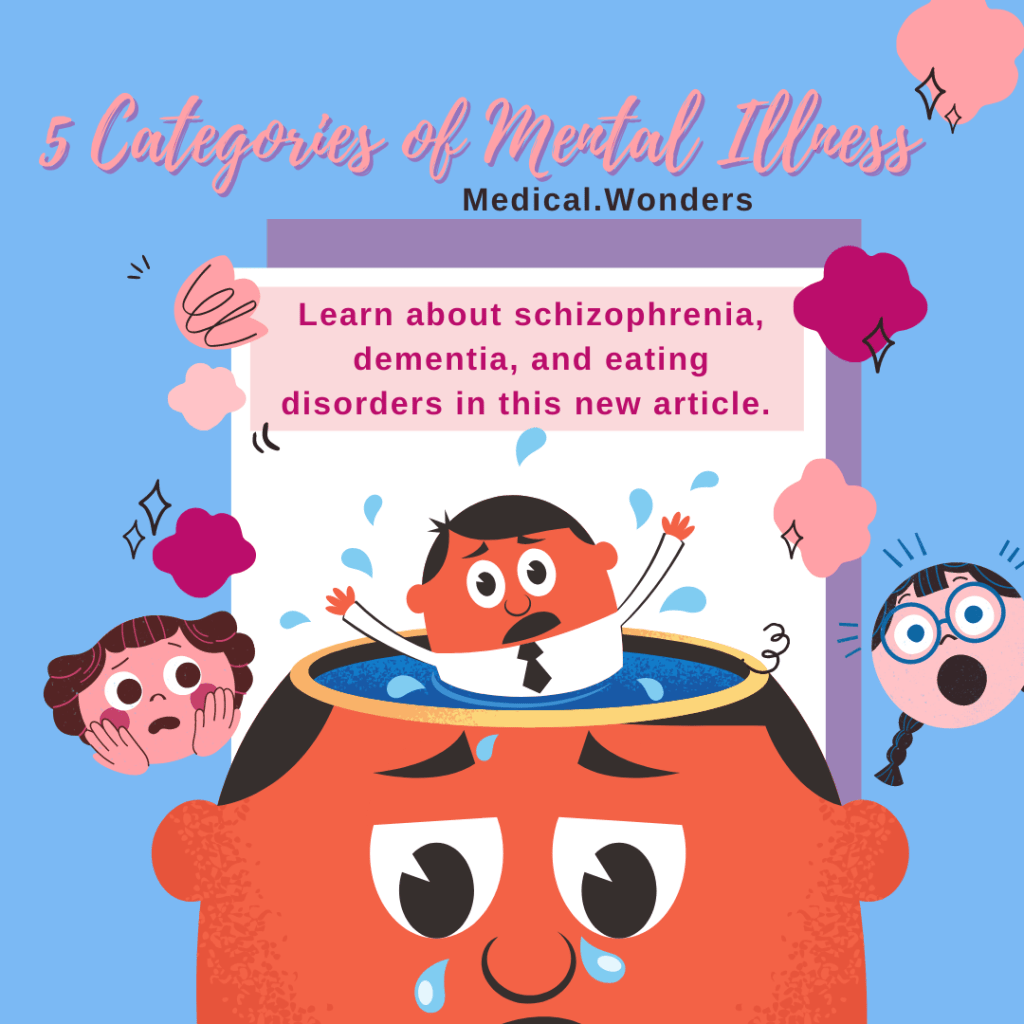
5 Categories of Mental Illness
By: Manisha Asrani
A mental illness is a condition that affects a person’s thinking, feeling, behavior or mood. These conditions deeply impact day-to-day living and may also affect the ability to relate to others. If you have, or think you might have, a mental illness, the first thing you must know is that you are not alone. Mental health conditions are far more common than you think. The main reason they may seem like they are not is because people don’t like to, or are scared to, talk about them. While there are over 200 classified forms of mental illness, there are 5 major categories of mental illness. They are anxiety disorders, mood disorders, psychotic disorders such as schizophrenia, dementia, and eating disorders.
All of us encounter anxiety in many forms throughout the course of our routine activities. However, the mechanisms that regulate anxiety may break down in a wide variety of circumstances, leading to excessive or inappropriate expressions of anxiety. An anxiety disorder may exist if the anxiety experienced is difficult for the individual to control, or interferes with normal functioning. More than 19 million American adults are affected by an anxiety disorder. Children and adolescents also develop anxiety disorders. People with anxiety disorders also have other physical or mental disorders, such as depression, eating disorders, substance abuse, cancer, or heart disease.
Most of us have an immediate and intuitive understanding of the notion of mood. We readily know what it means to be happy or sad. Mood disorders, however, are outside the bounds of normal fluctuations from sadness to elation. Mood disorders affect about 7% of Americans and rank among the top 10 causes of disability. Similar to anxiety disorders, mood disorders affect around 19-20 million American adults. Children and adolescents are also susceptible to mood disorders as well.
Schizophrenia is a serious brain disorder and is characterized by a profound disruption in cognition and emotion, affecting the most fundamental human attributes such as language, thought, perception, affect and sense of self. The array of symptoms include psychotic manifestations, such as hallucinations and delusions. Other symptoms include withdrawal, incoherent speech, and impaired reasoning.
Dementia is characterized by a disturbance of consciousness and a change in cognition, (including memory loss and a decline of intellectual and physical functioning), which develops over a short period. These disorders include Alzheimer’s, vascular dementia, dementia due to medical conditions such as HIV, and substance-induced dementia such as drug abuse.
Eating disorders are serious, sometimes life-threatening, conditions that tend to be chronic. Each year, more than five million Americans have an eating disorder. Onset usually occurs in adolescence and tends to predominantly affect females. Having an eating disorder is marked by extremes. It is present when a person experiences severe disturbances in eating behavior, such as extreme reduction of food intake, extreme overeating, or feelings of extreme distress or concern about body weight or shape. A person with an eating disorder may have started out just eating smaller or larger amounts of food than usual, however, at some point in time, the urge to eat less or more spirals out of control.
A mental health condition is not the result of one event. Research suggests multiple, linking causes. Genetics, environment, and lifestyle influence whether someone develops a mental health condition. A stressful job or home life makes some people more susceptible, as do traumatic life events. Biochemical processes and circuits and basic brain structure may play a role, too. This article displayed just a couple of types of mental illnesses, information about them, and how common they are.
Mental Illness: Possible Mental Health Treatments
By: Shania Ali
Nearly one in five (19 percent) of U.S. adults experience some form of mental illness. Mental illness has a huge impact on how a person lives their life. It affects their day to day living and involves changes in emotion, thinking, and behavior. Mental health is extremely important to take care of because it can affect your ability to function. The causes of mental illness can vary depending on one’s personal life. Regardless of the cause, there are several treatments that have helped millions of mental illness patients.
The first step for treatment is to go to a doctor to get diagnosed. From there, they will conduct a series of psychological exams and evaluations to determine the diagnosis. Some common classes of mental illness that people can be diagnosed with are:
- Neurodevelopmental disorders
- Examples may include: autism spectrum disorder and learning disorders
- Schizophrenia spectrum
- Can cause detachment from reality
- Examples may include: schizophrenia with hallucinations and delusions
- Bipolar and related disorders
- Period of excessive activity, energy, and excitement
- Related to depression
- Depressive disorders
- Can affect serotonin levels and overall emotional health
- Anxiety disorders
- Characterized by the anticipation of future danger or misfortune
- Examples may include: paranoia, panic disorder, and phobias
Once diagnosed, learn more about the disorder and choose what seems like the best treatment. Also, prepare to have a treatment team like family, a nurse practitioner, a physician assistant, or a psychiatrist. Some treatments patients decide to go through with are:
- Medications
- Examples may include: antidepressants, anti-anxiety medications, mood-stabilizing medications, and antipsychotic medications
- Psychotherapy
- Involves talking about one’s condition with a mental health professional
- Essentially getting a therapist
- Brain-stimulation treatments
- This includes electroconvulsive therapy, repetitive transcranial magnetic stimulation, and vagus nerve stimulation
- Hospital and residential treatment programs
- This is recommended when one is a danger to themselves and others
- Offers a temporary supportive place to live
- Home remedies
- This involves creating your own treatment plan and working together with the primary care provider to get better at home
The most important thing to understand about mental illnesses and mental health is that no one is alone.
Work Cited
“Mental Health: Types of Mental Illness.” WebMD, WebMD, https://www.webmd.com/mental-health/mental-health-types-illness.
“Types of Mental Illness.” Healthdirect, Healthdirect Australia, https://www.healthdirect.gov.au/types-of-mental-illness.
Mental Illness: Possible Mental Health Treatments
“Mental Illness.” Mayo Clinic, Mayo Foundation for Medical Education and Research, 8 June 2019, https://www.mayoclinic.org/diseases-conditions/mental-illness/diagnosis-treatment/drc-20374974.
“Mental Health Conditions.” NAMI, https://www.nami.org/About-Mental-Illness/Mental-Health-Conditions.
Parekh, Ranna. “What Is Mental Illness?” What Is Mental Illness?, https://www.psychiatry.org/patients-families/what-is-mental-illness.
 Medical Wonders