
Anorexia Nervosa in Nature vs Nurture
By: MariaJose Flores
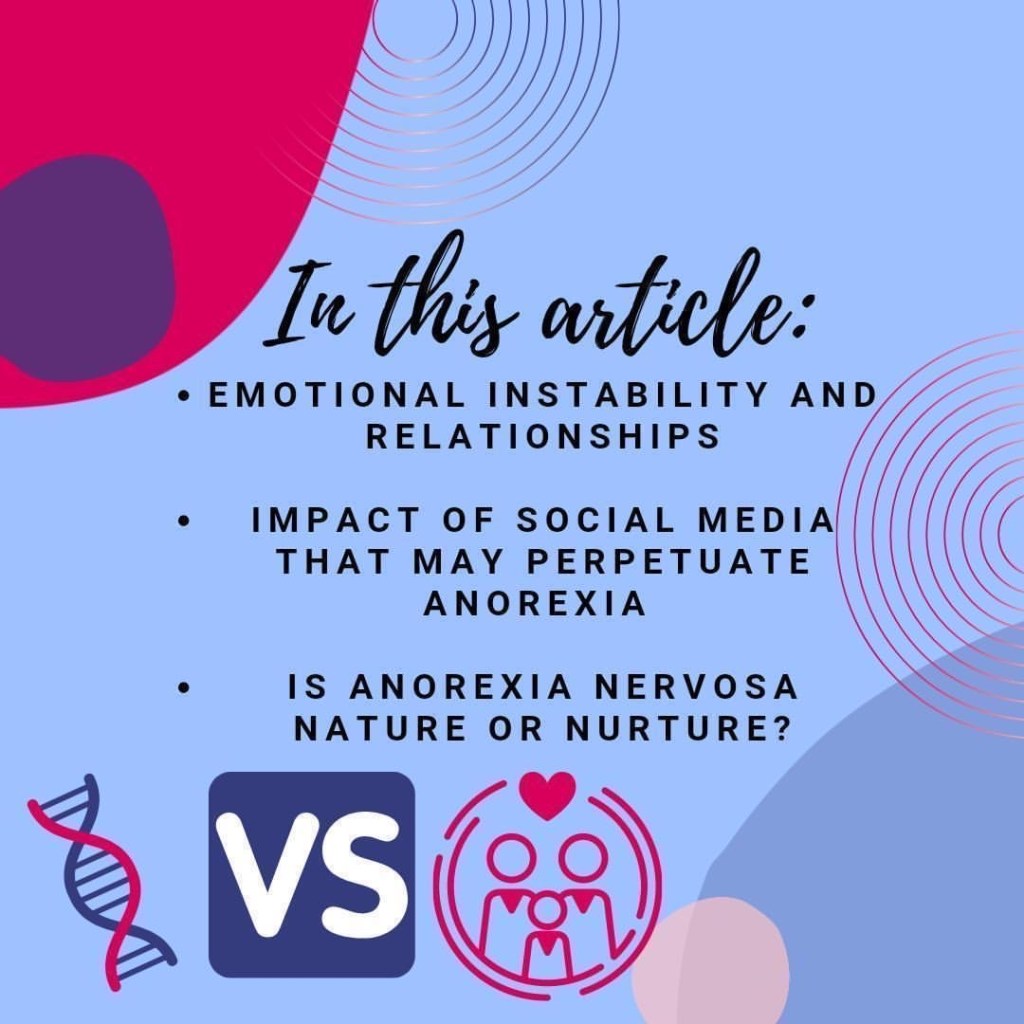
An evil good living inside our chamber of thoughts. Locked in this body, the light is too far away. Anorexia Nervosa is a mental illness with a “distorted perception of weight” (Anorexia Nervosa). It’s one of the numerous eating disorders that affects about “30 million people” just in the US (Eating disorders statistics). Anorexia forms part of a major concept which is personality, usually referred to as behavior. Anorexia is often being linked to the debate of nurture vs nature, nurture being past experiences that lead a person to be the way they are, and nature referring to genetics. Anorexia Nervosa is a life-threatening illness formulated by nurture, specifically through the dissection of personal relationships, the influence of social media, and the impact of the beauty industry.
Emotional instability is one of the most outlooked concepts concerning past trauma. Anorexia dominates over family support by cutting out communication, in which, occasionally help is shown in a variety of ways, although not all are presented the same way. Emotions can be demanding – they can make the relationship strained – making it more of a challenge to “open up,” providing the eating disorder a path to prosper and thrive without being disrupted. On the other hand, the person might feel “frustrated,” acknowledging the urgency of the situation by opening up, but instead, because of miscommunication, families resort to solving it “through their own ways” (Anorexia and Bulimia Care). When an eating disorder is presented, families often tend to be overprotective. Not even realizing their discharging ultimatums, unnecessary comments, shaming, blaming, and giving simple solutions (Smith). There is no such thing as “training” or “advice” when suddenly faced with “restricted eating, binging or purging.” At times, making parents “question their parenting skills,” opting to acknowledge the “why’s,” instead of the “just is” (Anorexia and Bulimia Care). People need “warm and safe environments,” to help them grow, learn, and understand what “strong relationships” are like (Family relationships important). With this in mind, social media is also a contributing factor to Anorexia Nervosa.
Instagram, Snapchat, Pinterest, VSCO, etc.; what is there not to love about social media? Images and advertisements can dictate an anorexic’s mind. Pictures often portray one side of the story – the happy, the perfect, and the unique – capable of influencing eating disorders with the most common being anorexia. 8-18-year-olds who are “engaged” with social media are connected for “about 7.5 hours per day” (NEDA Feeding Hope). As technology advances people advance with it as well. “Of American elementary school girls who read magazines, 69% say that the pictures make them want to lose weight” (NEDA Feeding Hope). Losing weight is not to be felt like a must, it should be a conscious decision made by someone to feel better for themselves. In the same way, advertisements often pose the same dangers. The name says it all – they are meant to promote a product. According to the website, Body image and advertising, “the average woman sees 400 to 600 advertisements per day, and by the time she is 17 years old, she has received over 250,000 commercial messages through the media” (Croft). Most of the advertisers have a plan, meaning “constructing an emotional experience that looks like reality,” creating “messages” according to what they want the audience to see. Making them feel “compelled” or bribed into buying the product (NEDA Feeding Hope). Similarly, the beauty industry revolves around Anorexia Nervosa.
Beautiful faces, perfect bodies, real-life angels. The beauty industry tends to point out the shape of a person from standards known as, “the thin ideal.” According to Western beauty pressures, “despite the high failure rate of the weight loss industry, pressure on women and girls to meet the thin Western beauty “ideal” remains. In contemporary Western culture, the thin female body is associated with health, wealth, success and beauty” (Mckay). In other words, the thin ideal is brought along by many stereotypes, the most popular being what a person should look like. In this case, the level of perfection that a person should be capable of reaching. Beauty magazines often become “how-to manuals”, guiding women struggling with eating disorders, in “attempts to obtain an elusive and impossible standard of physical thinness.” Rooting for the “anorexic desire to restrict”, and at times ignoring comments from people around them while pointing out the obvious by “promoting” messages that approve of thinness and dieting (Spettigue). Messing with the person’s mind, not letting them be capable of realizing the harm they’re causing themselves. Anyone can believe they’re beautiful; the problem comes when the person feels as if they have to go to extremes in order to reach it.
Develop usually means to grow or cause to grow. Some might argue that anorexia is caused by genetics, the brain’s structure. However, there’s a significant amount of evidence showing how it’s developed from psychological, environmental, and social factors. According to ULifeline, “in fact, eating disorders are common in individuals who struggle with clinical depression, anxiety disorders, and obsessive-compulsive disorders. Other factors include low self-esteem, feelings of hopelessness and inadequacy, trouble coping with emotions or expressing your emotions, and perfectionism impulsivity.” This demonstrates that the development of an eating disorder is related to how the person copes mentally. Similarly, culture and environment play a part in anorexia. Seemingly normal, society encourages “the thin ideal, dieting, and body dissatisfaction” (ULifeline). Although genetics and the brain’s structure is often mentioned as to why this illness develops, there is no actual proof to say it’s correct. According to Eating disorder hope, “research results showed results of possible chromosomes 1 and 10 that appear to be significantly linked to anorexia and bulimia” (Ekern). Keyword, possible. Better known as a hypothesis, experiments are made but they all end with words such as possibility, chance, etc. While there is no actual proof that anorexia is caused by genetic factors, there is sufficient information for the nurture side.
As previously mentioned before, anorexia nervosa is produced by nurture, specifically through the evaluation of personal relationships, social media influence and the impact of the beauty industry. Anorexia is a life-threatening illness, in which one goes against their own health in order to achieve a major, often unrealistic goal.
Works Cited
“Anorexia Nervosa.” Mayo Clinic, Mayo Foundation for Medical Education and Research, 20 Feb. 2018, http://www.mayoclinic.org/diseases-conditions/anorexia-nervosa/symptoms-causes/syc-20353591.
“Eating Disorder Statistics • National Association of Anorexia Nervosa and Associated Disorders.” National Association of Anorexia Nervosa and Associated Disorders, anad.org/education-and-awareness/about-eating-disorders/eating-disorders-statistics/.
“Family Involvement – The Role of Family in Eating Disorders.” Eating Disorder Hope, http://www.eatingdisorderhope.com/treatment-for-eating-disorders/family-role.
“Helping Someone with an Eating Disorder.” HelpGuide.org, 17 June 2019, http://www.helpguide.org/articles/eating-disorders/helping-someone-with-an-eating-disorder.htm.
Mckay, Ashley, et al. “Western Beauty Pressures and Their Impact on Young University Women.” International Journal Of Gender & Women’s Studies, vol. 6, no. 2, 2018, doi:10.15640/ijgws.v6n2a1.
“Media & Eating Disorders.” National Eating Disorders Association, 22 Feb. 2018, http://www.nationaleatingdisorders.org/media-eating-disorders.
Spettigue, Wendy, and Katherine A Henderson. “Eating Disorders and the Role of the Media.” The Canadian Child and Adolescent Psychiatry Review = La Revue Canadienne De Psychiatrie De L’enfant Et De L’adolescent, Canadian Academy of Child and Adolescent Psychiatry, Feb. 2004, http://www.ncbi.nlm.nih.gov/pmc/articles/PMC2533817/.
StackPath, http://www.healthyplace.com/eating-disorders/articles/eating-disorders-body-image-and-advertising.“Why Are Healthy Family Relationships Important?” Why Are Healthy Family Relationships Important? | Relationships Australia Queensland, http://www.raq.org.au/faq/why-are-healthy-family-relationships-important.
 Medical Wonders