Common Reproductive System Diseases in Women
By: Truc Le
- Cervical Cancer:
Cervical cancer is a malignant neoplasm that originates from cells in the cervix uteri (Boundless). It is most common (90+%) caused by human papillomavirus (HPV), a virus that enters body cells and uses its own genetic material to interfere in the host cell’s metabolic machinery and produce more virus. HPV is a large family with 100 related viruses. HPV infections happen in both men and women with different race, age, sexual partners, and ethnicity. According to WHO, it usually takes from a few months to two years to clear up HPV infections. Otherwise, it can persist and progress to cancer.
Cervical cancer can be diagnosed by the Pap smear screening which can effectively identify precancerous and potentially precancerous changes in cervical cells and tissue. However, a biopsy of the cervix is required to confirm the cervical cancer or pre-cancer.
People with pre diagnosed with some types of human papillomavirus and smoking habit have a higher risk of developing cervical cancer. Other risk factors include having unprotected sex, having multiple sexual partners, a first sexual experience at a younger age, failure to receive the HPV vaccine, and a compromised immune system.
Cervical cancer might have completely no symptoms until it has progressed to an advanced stage. Some common symptoms include loss of appetite, weight loss, fatigue, pelvic pain, back pain, leg pain, swollen legs, heavy bleeding from the vagina, and bone fractures.
HIV vaccines were first approved in 2006 and are recommended to every girl aged 9-13 years because it is the “most cost-effective public health measure against cervical cancer” (WHO). Now, there are two brands available: Gardasil and Cervarix. However, regular Pap smear screening for women is still recommended, even after vaccination.
- Pelvic Inflammatory Disease (PID):
Pelvic inflammatory disease (PID) is an infection of the female reproductive organs. Unlike in men, the abdominal cavity in women is open to the external environment through the reproductive tract, making it more vulnerable to infections and inflammation. The bacteria can enter via the vagina and then travel to the cervix, the uterus and fallopian tubes, and the pelvic cavity. Any infection in these places can cause PID.
Symptoms include pain in your lower abdomen, fever, an unusual discharge with a bad odor from your vagina, pain and/or bleeding when you have sex, burning sensation when you urinate, or bleeding between periods. According to the CDC, there is no test for PID. Therefore, if you have any symptoms, doctors should be viewed immediately.
Some risk factors are being a sexually active woman younger than 25 years old, having multiple sexual partners, being in a sexual relationship with a person who has more than one sex partner, having sex without a condom, douching regularly, which upsets the balance of good versus harmful bacteria in the vagina and might mask symptoms, having a history of pelvic inflammatory disease or a sexually transmitted infection.
Although this is a common disorder, PID can be cured if it is diagnosed early. In other words, the longer you wait, the more complications the treatment is. Treatment includes medications, hospitalization, surgery and interventional radiology techniques.
- Ovarian cyst:
The ovaries are the female gonads which are used to develop and mature the ova during the menstrual period. Cysts, which are fluid-filled sacs, can be formed on the external or internal surface of the ovaries with different sizes. They are not necessarily harmful and rarely have symptoms. However, in some cases, these cysts might get too big and cause serious problems. They can alter the hormone production in the ovaries.
Usually, there is no need for treatment because ovarian cysts happen frequently and generally disappear. However, in some severe cases when patients have abdominal pain, abdominal swelling, painful sexual intercourse, menstrual irregularities, and unusual hair growth on the face and body, surgery might be advised to remove the cysts.
You will be more likely to develop an ovarian cyst if you have hormonal problems, pregnancy, endometriosis, a severe pelvic infection, and a previous ovarian cyst. Although there is no prevention, regular pelvic exams are recommended for helping diagnose the disease as soon as possible.
Ovarian Cancer
By: Lisa Kim
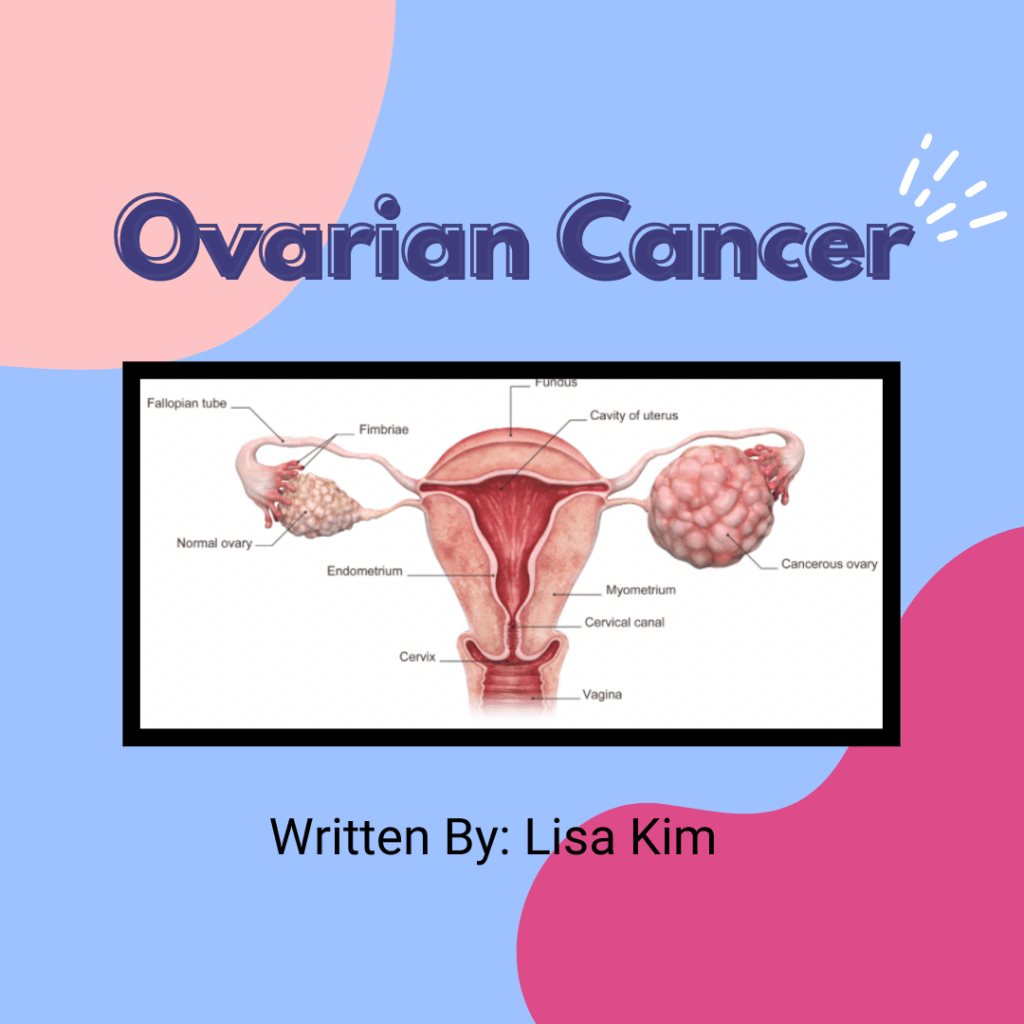
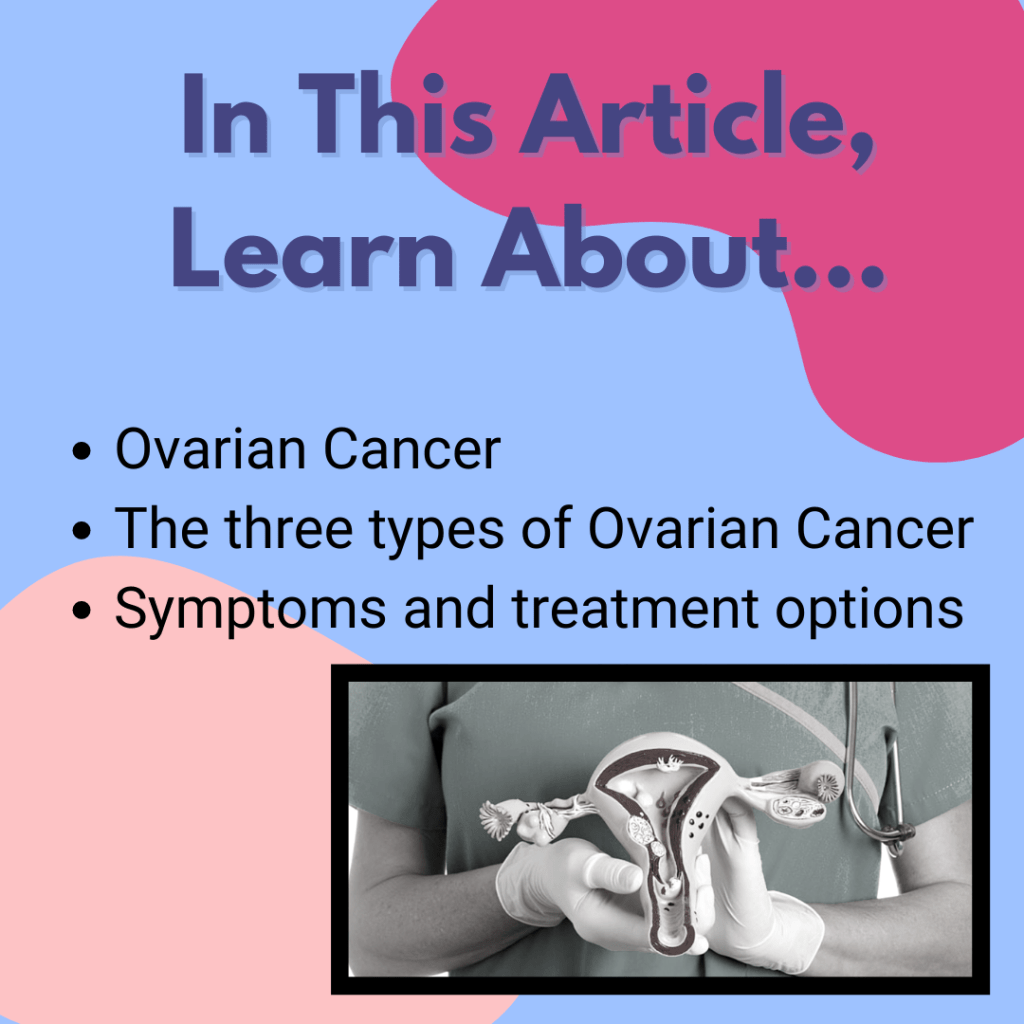
Ovarian cancer is the second most common gynecologic cancer but more women die from this cancer than any other gynecologic cancer (Merck Manual). Ovaries are small yet vital organs within a female’s reproductive system. Every woman has two ovaries, one on each side of the uterus. They are responsible for producing ova and hormones such as progesterone and estrogen (Mayo Clinic). Ova, more commonly known as egg cells, become fertilized by sperm cells, forming a zygote which will then develop into a human fetus. Estrogen and progesterone are important hormones that are involved in a women’s sexual and reproductive development such as their menstrual cycle. Therefore, ovarian cancer is a serious and dangerous disease as it can affect one’s fertility and is capable of spreading to nearby tissue in the pelvis. Throughout this article, the different types, symptoms, and treatment options of ovarian cancer will be discussed.
There are three types of ovarian cancer: epithelial tumors, stromal tumors, and germ cell tumors (Mayo Clinic). Epithelial tumors develop on the outer layer of ovaries, stromal tumors develop within ovary tissue, and germ cell tumors develop in cells responsible for producing egg cells. Once patients are diagnosed with a type of ovarian cancer, they will also learn which stage of cancer they are in. The stages of ovarian cancer range from I (earliest) to IV (latest).
Ovarian cancer usually develops on the surface of a woman’s ovaries. Unfortunately, symptoms of ovarian cancer tend to present themselves mainly in the later stages. Consequently, most women get diagnosed during the latest stages of ovarian cancer. As a result, only 15% of women are diagnosed before the disease spreads and the overall survival rate is less than 50% (healthywomen). The symptoms include but are not limited to:
- Bloating
- Urinary frequency
- Constipation, changes in bowel movements, upset stomachs
- Feeling full quickly wheOvarian Cancer
- n eating
- Discomfort within the pelvis area
The most common treatment options for ovarian cancer include cytoreductive surgery, an oophorectomy, and chemotherapy (Merck Manual). A cytoreductive surgery is the complete removal of cancerous tissue, and an oophorectomy is the removal of one’s ovaries. Since ovarian cancer spreads easily, oftentimes the removal of one’s uterus is also needed. Lastly, chemotherapy can be used either before or after surgery to help shrink a tumor. Patients could require a combination or only one of the treatment options described. In the end, the method used to treat ovarian cancer depends on the type and severity of their cancer.
In summary, the three main types, symptoms, and treatment options of ovarian cancer were described. It is important to learn more about different types of cancers. It not only expands our knowledge but also helps spread more awareness of the diseases that can affect our friends and family.
Work Cited:
Common Reproductive System Diseases in Women
“11 Major Reproductive System Diseases in Women.” New Health Advisor, 3 May 2020, www.newhealthadvisor.org/Female-Reproductive-System-Diseases.html.
Betts, J. Gordon. “THE REPRODUCTIVE SYSTEM.” Anatomy and Physiology, edited by Kelly A. Young et al., OpenStax, 2013, pp. 1279–318.
Boundless. “Diseases and Disorders of the Reproductive System | Boundless Anatomy and Physiology.” Lumen, courses.lumenlearning.com/boundless-ap/chapter/diseases-and-disorders-of-the-reproductive-system. Accessed 11 July 2021
“Cervical Cancer.” World Health Organization, 27 Aug. 2018, www.who.int/westernpacific/health-topics/cervical-cancer.
Isaac, M. “Diseases of Human Reproductive System.” Organs of the Body, 17 Oct. 2020, reproductivesystem.organsofthebody.com/reproductive-system-diseases.php.
“Ovarian Cysts – Symptoms and Causes.” Mayo Clinic, 26 Aug. 2020, www.mayoclinic.org/diseases-conditions/ovarian-cysts/symptoms-causes/syc-20353405.
“Pelvic Inflammatory Disease – CDC Fact Sheet.” Centers for Disease Control and Prevention, http://www.cdc.gov/std/pid/stdfact-pid.htm. Accessed 11 July 2021.
“Pelvic Inflammatory Disease (PID) – Symptoms and Causes.” Mayo Clinic, 23 Apr. 2020, http://www.mayoclinic.org/diseases-conditions/pelvic-inflammatory-disease/symptoms-causes/syc-20352594.
Ovarian Cancer
Cancer.Net. “Understanding Chemotherapy.” Cancer.Net, May 2019, https://www.cancer.net/navigating-cancer-care/how-cancer-treated/chemotherapy/understanding-chemotherapy. Accessed 12 July 2021.
Cleveland Clinic. “Female Reproductive System.” Cleveland Clinic, 2019, https://my.clevelandclinic.org/health/articles/9118-female-reproductive-system. Accessed 15 July 2021.
healthywomen. “Ovarian Cancer.” healthywomen, https://www.healthywomen.org/condition/ovarian-cancer/overview. Accessed 15 July 2021.
Mayo Clinic. “Ovarian cancer.” Mayo Clinic, 25 July 2019, https://www.mayoclinic.org/diseases-conditions/ovarian-cancer/symptoms-causes/syc-20375941. Accessed 12 July 2021.
Merck Manual, et al. “Ovarian Cancer.” Merck Manual Consumer Version, September 2020, https://www.merckmanuals.com/home/women-s-health-issues/cancers-of-the-female-reproductive-system/ovarian-cancer. Accessed 15 July 2021.
You and your Hormones. “Ovaries.” You and your Hormones, February 2018, https://www.yourhormones.info/glands/ovaries/. Accessed 15 July 2021.
 Medical Wonders