
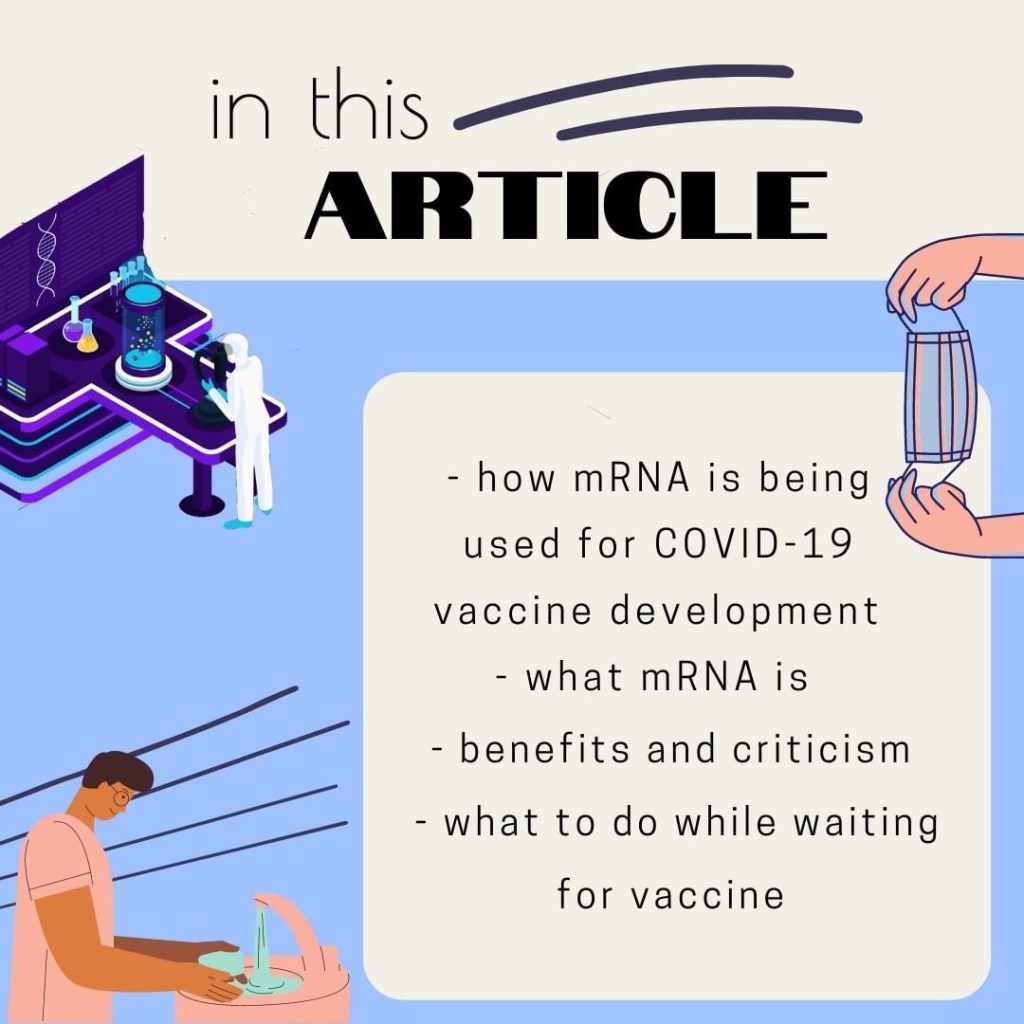
The Science and Feasibility of mRNA Vaccines
By: Saivishnu Tulugu
With over 60 million documented cases worldwide, the novel coronavirus pandemic has left a profound impact on the health, economy, and livelihood on humanity. However, recently pharmaceutical giants Moderna and Pfizer introduced a vaccine that could be used to contain the spread of this pathogen. The Moderna vaccine that was co-developed by the National Institute of Allergy and Infectious Diseases (NIAID) uses an mRNA-1273 to inhibit replication of SARS-COV-2, the pathogen that causes COVID-19. This article will explore the science behind an mRNA vaccine and the broader implications of this discovery.
Messenger RNA or mRNA is a single stranded molecule that is used by the ribosome in order to translate triplets of nucleotide base pairs into amino acids (NIH). As building blocks of proteins, amino acids allow for the development of proteins. By studying how mRNA affects translation of proteins in the human body and COVID-19, they were able to develop a vaccine that targets the spike glycoprotein (S-2P) in the virus. This spike protein allows for the virus to enter, infect, and replicate human cells. By inhibiting the production of the S-2P protein, the vaccine renders the virus as it is no longer able to reproduce (Jackson et. al). Without replication the virus cannot infect new hosts and thus will eventually die out.
Despite the 94.5% efficacy rate in a phase 3 clinical trial, some critics have raised concerns about the administration of this vaccine. For one, there are currently no licenced mRNA vaccines on the market (CDC). Thus, it is uncertain if the vaccine will have unforeseen long term effects or how it affects the immune response in the body. Furthermore, some incorrectly claim that mRNA permanently alters the cellular DNA of an individual. However, the CDC explains that after mRNA is transcribed it is broken down and discarded by the cell. They also explain that all COVID-19 vaccines are subject to a strict evaluation process by the FDA to ensure no undefined ill-effects.
So what can you do as an everyday citizen? For one, you should continue wearing a mask and washing your hands. The distribution of the vaccine is expected to be the largest vaccine administration project in human history and will inevitably face some road blocks. Another thing you can do is to continue to educate yourself about science so you know exactly how the vaccine will work and what to expect when you receive one. But whatever the vaccine administration schedule looks like, this mRNA COVID-19 vaccine marks a pivotal development in scientific history.

How does a pandemic affect mental health?
By: Pranja D
COVID-19, coronavirus disease 2019, has been a major event in the world’s history, and it continues to live on and affect many people around the world. COVID-19 has affected every aspect of people’s lives and it will continue to do so for the foreseeable future. This epidemic has not only produced physical effects to people who contracted the virus, but also emotional and mental effects for anyone, regardless of whether or not the person contracted the virus.
This particular outbreak has forced everyone to take extreme safety measures that may make people feel stressed and worried about the future. The stress associated with this epidemic may cause people to feel worried about their health and the health of their loved ones, and feelings of isolation and loneliness can arise due to the strict social distancing protocols that are required to keep everyone safe (CDC, 2020). According to a poll conducted in July of 2020, “53% of adults in the United States reported that their mental health has been negatively impacted due to worry and stress over the coronavirus. This is significantly higher than the 32% reported in March” (Panchal, et al., 2020). These stressors present in many people today can lead to unhealthy habits that need to be reversed through connecting with others, calling national help hotlines, taking breaks from the news, and more.
It is normal to feel stressed and worried during an unprecedented time. The major shifts in life have led to many people working from home, homeschooling, and major reduction in socializing with others the same way as before the pandemic (World Health Organization, n.d.). The normal chaos of life has turned into a new normal consisting of staying at least 6 feet away from others and wearing masks. Even though this stress may be common among many people today, it is still important to reach out and get help when needed.
Work Cited:
The Science and Feasibility of mRNA Vaccines
CDC. (2020). Understanding mRNA COVID-19 Vaccines. Retrieved December 02, 2020, from https://www.cdc.gov/coronavirus/2019-ncov/vaccines/different-vaccines/mrna.html
Jackson, N.A.C., Kester, K.E., Casimiro, D. et al. The promise of mRNA vaccines: a biotech and industrial perspective. npj Vaccines 5, 11 (2020). https://doi.org/10.1038/s41541-020-0159-8
NIH. (2020, November 16). Promising Interim Results from Clinical Trial of NIH-Moderna COVID-19 Vaccine. Retrieved December 02, 2020, from https://www.nih.gov/news-events/news-releases/promising-interim-results-clinical-trial-nih-moderna-covid-19-vaccine
How does a pandemic affect mental health?
CDC. (2020, July 1). Coronavirus Disease 2019 (COVID-19)- Stress & Coping. Retrieved from https://www.cdc.gov/coronavirus/2019-ncov/daily-life-coping/managing-stress-anxiety.html
World Health Organization. (n.d.) Mental health and COVID-19. Retrieved from https://www.who.int/teams/mental-health-and-substance-use/covid-19Panchal, N., Kamal, R., Orgera, K., Cox, C., Garfield, R., Hamel, L., Muñana, C., Chidambaram, P. (2020, August 21). The Implications of COVID-19 for Mental Health and Substance Use. Retrieved from https://www.kff.org/coronavirus-covid-19/issue-brief/the-implications-of-covid-19-for-mental-health-and-substance-use/
 Medical Wonders