
Hirsutism
By: Saivishnu Tulugu
Hirsutism is a condition that occurs when women grow hair in unconventional areas such as the face, chest, and back. The primary reason for the onset of disease is excessive androgens in a woman’s body. Although typical associated with development of male sex organs, androgens play an essentail role in maintaining homeostasis in a woman’s body. Research suggests that androgens in women are known to prevent bone damage, maintain reproductive function, and stimulate hair growth in the pubic and axillary areas (Chhabra et. al).
In hirsutism, the excess of male sex hormones in a woman’s body is often associated with polycystic ovary syndrome (PCOS). PCOS is known to result in excessive hair growth (hirsutism), irregular periods, and infertility in certain situations. However, there are some cases of hirsutism not associated with hirsutism but linked to epigenetic factors (Krouni et. al). Women of South Asian and Middle Eastern women are more prone to develop hirsutism than any other demographic. Other factors such as dietary intake, exposure to environmental pollutants, and family history may affect onset.
As hirsutism is typically associated with an aesthetic difference, it typically does not need to be treated unless it is associated with secondary diseases such as PCOS. In extreme situations a physician may prescribe anti-androgen medications to mitigate the effects of this compound in a woman’s body. External procedures such as laser therapy and electrolysis are also often considered to physically remove hair in invasive areas (Alizadeh et. al).
However, it should be a woman’s choice to determine to remove the hair or not. Awareness needs to be raised to educate people that hirsutism is a natural condition and is not an indication of hypermasculinity in a woman. Furthermore, research needs to be conducted to understand why PCOS is associated with hirsutism.
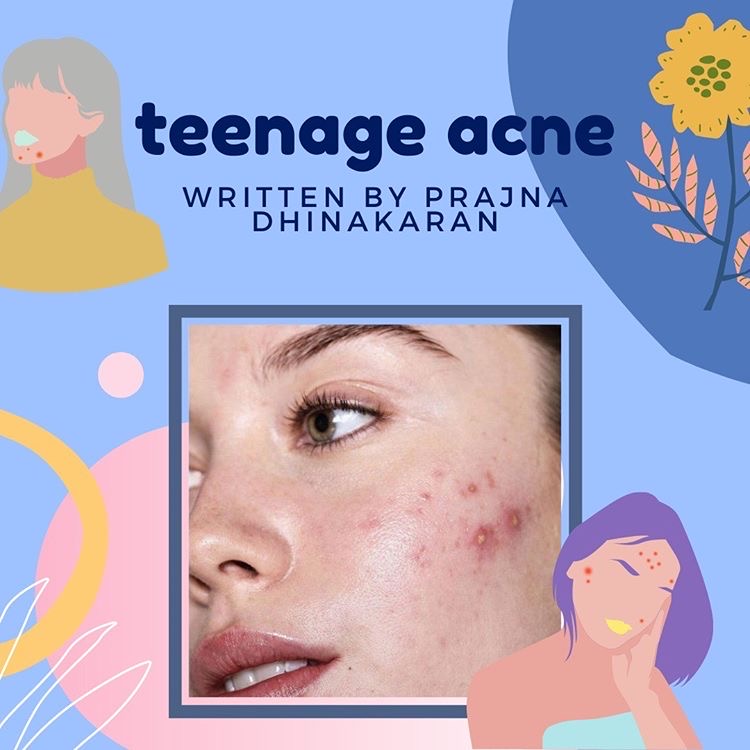
What is teenage acne…and how can I get rid of it?
By: Prajna Dhinakaran
Acne is a very common skin issue amongst teenagers that goes beyond just its physical presentation, often affecting self-esteem and confidence. Approximately 85% of teenagers get acne starting around the age of 11 in girls and sometimes later in boys (Lamb, n.d.). Acne can continue into adult years as well, especially in women around the time of their menstruation. Doctors have studied the causes of acne for years, and now have several different options for treating acne that have proven themselves effective for individuals struggling with their skin.
Before attempting to treat teenage acne, it is important to understand what causes it. The main cause of acne is when hair follicles get blocked by the oil produced by sebaceous glands. These glands surround follicles and are stimulated by hormonal changes that occur most often during puberty. When the hair follicles get blocked, the sebum can not escape which leads to whiteheads (Stanford Children’s Health, n.d.). Whiteheads can turn into blackheads if exposed to the air, and they can form cystic pimples if the bacteria multiplies within the whitehead (Lamb, n.d.). In addition to hormonal changes, stress, diet, and certain medications can also contribute to the worsening of acne (Mayo Clinic, n.d.).
After examining what types of acne are seen on the skin, the appropriate treatment must be chosen. Generally, the best method to reduce acne is keeping the skin clean and moisturized. Cleansing the skin twice a day is crucial, especially for oily skin. Using non-comedogenic products will not worsen acne and will prevent the emergence of new breakouts. For more persistent cases of acne, one might seek professional help where acne treatments may be prescribed.
Teenage acne can be difficult to experience, and may be degrading to self-esteem; however, with proper care and consultations, acne is a treatable condition.
WORD CITED:
Hirsutism:
Alizadeh, N., Ayyoubi, S., Naghipour, M., Hassanzadeh, R., Mohtasham-Amiri, Z., Zaresharifi, S., & Gharaei Nejad, K. (2017). Can laser treatment improve quality of life of hirsute women?. International journal of women’s health, 9, 777–780. https://doi.org/10.2147/IJWH.S137910
Chhabra, S., Gautam, R. K., Kulshreshtha, B., Prasad, A., & Sharma, N. (2012). Hirsutism: A Clinico-investigative Study. International journal of trichology, 4(4), 246–250. https://doi.org/10.4103/0974-7753.111204
Krouni, A., Forouhari, S., Namavarjahromi, B., Dabbaghmanesh, M. H., Shayan, A., Sepasi, S., & Zare, A. (2017). The evaluation of the relationship between some related hormone levels and diet in obese or overweight patients with hirsutism: A randomized clinical trial. Journal of family medicine and primary care, 6(4), 755–759. https://doi.org/10.4103/jfmpc.jfmpc_179_17
Sachdeva S. (2010). Hirsutism: evaluation and treatment. Indian journal of dermatology, 55(1), 3–7. https://doi.org/10.4103/0019-5154.60342
What is teenage acne…and how can I get rid of it?
Lamb, P. (n.d.). Checkup on Health. Retrieved from https://health.ucdavis.edu/welcome/features/20090909_teen_acne/#:~:text=a lucky minority.-,It is estimated that 85 percent of teens get acne,to be bothered by it
Mayo Clinic. (2020, September 12). Acne. Retrieved from https://www.mayoclinic.org/diseases-conditions/acne/symptoms-causes/syc-20368047
Stanford Children’s Health. (n.d.). Treating Teen Acne. Retrieved from https://www.stanfordchildrens.org/en/topic/default?id=treating-teen-acne-1-1252
 Medical Wonders